

Të dhënat po ngarkohen...



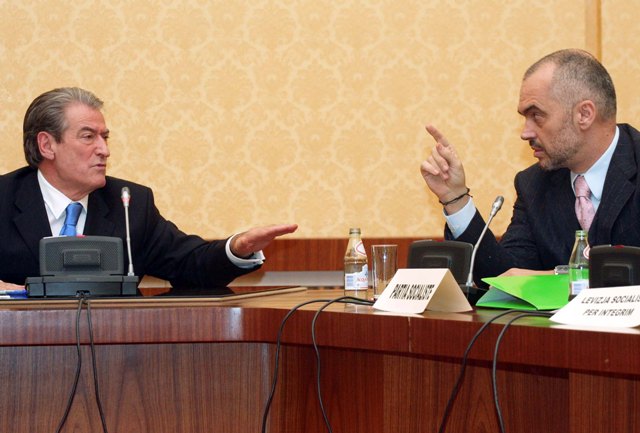
Ljubljana, February, 15 2012 – The International Institute for Middle-East and Balkan Studies (IFIMES) in Ljubljana, Slovenia, regularly analyses events in the Middle East and the Balkans. IFIMES has analysed the current situation in Albania in view of the first anniversary of opposition protests and the centenary of independence that the state marks this year.
The most relevant and interesting sections from the comprehensive analysis entitled “ALBANIA’S FIGHT AGAINST ITSELF” are published below.
ALBANIA:
ALBANIA’S FIGHT AGAINST ITSELF
THE CENTURY OF INDEPENDENCE
In 2012 the Republic of Albania marks the centenary since it proclaimed independence on 28 November 1912 in Vlorë, where the Declaration of Independence was adopted after a decade of fighting. 100 years later, Albania is a member of NATO and on its way to gain the status of EU candidate country this year. However, in order to achieve that goal, it has to implement numerous reforms, especially in the justice system, as well as to meet certain political demands, start fighting corruption more seriously and establish a political dialogue between the leading coalition and the opposition parties.
This year will represent a turning point for Albania, not only because of the centenary of independence, but also due to numerous important events at both domestic and international political levels.
ILIR META FREED FROM RESPONSIBILITY
More than one year has passed since the public learnt of the affair related to the former Deputy Prime Minister and Minister of Economy, Telecommunication and Energy Ilir Meta, who is the leader of the Socialist Movement for Integration (LSI). The affair broke out when the former Minister of Economy, Trade and Energy Dritan Prifti, who was also LSI Vice-Chairman, secretly filmed a video of his meeting with Ilir Meta at which they were allegedly discussing the fixing of certain tenders and the taking of bribes.
Throughout the affair Meta denied being involved in staging tenders in any way and claimed that the meeting which Prifti secretly recorded was not related to the fixing of tenders and the taking of bribes. The video that was published by the media only shows that Meta and Prifti met. The tone of the recording is of poor quality with many interruptions, so it is very difficult to determine what Meta actually said. In order to resolve the dilemmas, Albanian Public Prosecutor’s Office asked the U.S. for expert assistance to find out what was said at the meeting. American experts analysed the recording and confirmed that the video was real and untouched by technological devices. However, at certain parts of the recording it is still not clear what exactly Meta and Prifti were saying.
After the affair broke out Meta resigned as Deputy Prime Minister and Minister of the Economy and expressed his readiness to co-operate in the investigation in order to confirm the truth in the case.
The court trial lasted one year and ended on 16 January 2012 when the High Court of Tirana adopted the legally binding ruling in which it found Ilir Meta not guilty, establishing there was insufficient evidence to prove his involvement in corruption and misuse of official position. The prosecution had demanded a two year prison sentence and a fine of one million leks (EUR 7000).
The reactions to the court decision were contradictory: while the Government and the ruling Democratic Party (PD) as well as LSI welcomed the ruling calling it a victory for the rule of law, the opposition Socialist Party (PS) regarded it as a defeat of the rule of law.
Analysts have pointed to the fact that the affair is the result of a personal conflict between Ilir Meta and Dritan Prifti, after the latter was replaced as Minister of Economy, Trade and Energy by Meta (i.e. the LSI), so the whole affair is regarded as Prifti’s revenge for his dismissal. This can be further confirmed by Prifti’s shift from LSI to the Socialist Party during his term of office as member of the Albanian parliament.
Prime Minister Sali Berisha would probably like to see Ilir Meta in the government team, preferably as foreign minister, in order to strengthen this ministry. The fact is that Meta was very successful as foreign minister, which is an important aspect for a country hoping for EU membership. From the legal point of view Ilir Meta is innocent, while in terms of political ratings his position and that of other political parties will be determined at the next parliamentary election which is to take place in 2013.
21 JANUARY – ONE YEAR LATER
One year has passed since the protests led by the opposition Socialist Party took place. The events of 21 January 2011 had a tragic outcome: four protesters were killed and hundreds injured. Prime Minister Berisha claimed, and still claims, that the demonstrations were an attempt of coup d’état, while the opposition regarded the protests as a peaceful and democratic form of expressing citizens’ dissatisfaction with the present government. The opposition believes that the incidents and clashes were provoked by the police and the guards.
Once again the Americans entered the scene, and FBI was asked to investigate the incident. The investigation confirmed that the police was the first to open fire on protesters. The official video recording of the demonstration was deliberately removed from the server. Further investigations will show what Prime Minister Berisha wanted to hide on that video and who was responsible for the death of four protesters. It is unthinkable that such assassinations have happened in a European state and a NATO member.
The IFIMES International Institute has estimated that in view of the present situation it will be very difficult for Albania to gain the status of the candidate country until the incidents of 21 January 2011 are resolved and the responsible persons punished. The rule of law is one of the cornerstones on which the European Union is built, and Albania is lagging far behind in this field.
TOPI WITH A NEW PARTY – WILL BERISHA’S GOVERNMENT FALL?
The Republic of Albania will hold indirect presidential election this year. In mid-July the Albanian parliament will elect new president of the Republic. Five years ago Bamir Topi was elected to this position after five rounds of voting. At that time Sali Berisha strongly supported Bamir Topi who was also Vice-Chairman of his Democratic Party (PD).
Today, Topi is the first on the list of people Berisha wishes to eliminate from political life, followed by the opposition leader Edi Rama. This once again confirms the many times revealed Berisha’s inconsistent personality.
Even if Bamir Topi is no longer Albania’s president, this definitely does not mean he will leave the political scene. On the contrary, Topi is forming his own centre-right party that may become the main competitor to Berisha’s Democratic Party, and this is what worries Berisha most. Topi is regarded as one of the most popular politicians among the long-term members of the Democratic Party and enjoys the support of some eminent and influential members such as former Foreign Minister Besnik Mustafaj as well as certain current MPs from the Democratic Party, notably former Deputy Prime Minister and former Defence Minister Gazmend Oketa.
The IFIMES International Institute is of the opinion that Berisha’s government which holds the parliamentary majority of four MPs may fall the moment Albania’s current President Bamir Topi establishes his own party, depending on how many MPs from the Democratic Party join Topi’s party. In that case early parliamentary election might be held this autumn. That would mean an end of Sali Berisha’s prolific but at the same time controversial political carrier which he started as a personal physician of Albanian dictator Enver Hoxha, to be elected as Albania’s president in early 1990s and finally serving two consecutive terms of offices as Prime Minister since 2005.
The IFIMES International Institute considers that Albania bears the main responsibility for the slow pace of gaining EU membership because its actions can often be understood as self-destructive. Unless the general consensus is reached at the national level and mutual co-operation established between political parties, the state can not make any significant progress towards EU membership. There will be no economic progress without foreign investment. In order to increase foreign investment, improvements should be made in the business environment, which is again the responsibility of the government. The government has to ensure that domestic and foreign companies can compete on an equal footing in order to prevent discrimination against companies in foreign ownership, for example when the Albanian Tax Administration does not refund VAT to companies in foreign ownership.
